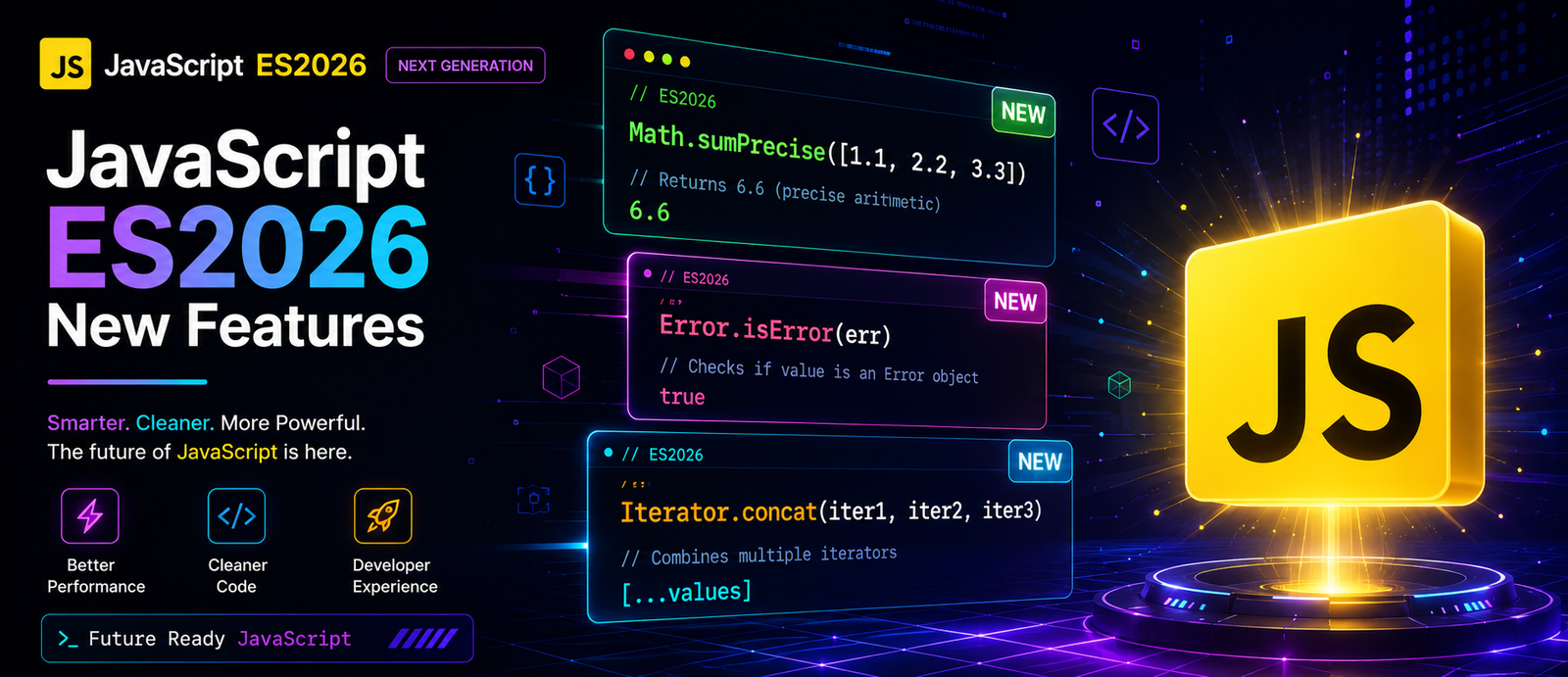
6 New JavaScript Features in ES2026 That Will Actually Change How You Code
JavaScript keeps evolving, and ES2026 (finalized by TC39 in late 2025) is one of the most practical updates in years. No flashy syntax changes — just six quality-of-life features that eliminate real, everyday pain points. Let's break down each one, why it matters, and where you can use it today.
1. Math.sumPrecise() — Accurate Floating-Point Summation
Every JavaScript developer has seen this at least once:
console.log(0.1 + 0.2); // 0.30000000000000004 😱
This happens because JavaScript numbers are IEEE 754 floating-point values, and errors accumulate as you add more numbers together:
[0.1, 0.2, 0.3, 0.4].reduce((a, b) => a + b, 0);
// 1.0000000000000002
ES2026 introduces Math.sumPrecise(), which takes an iterable of numbers and sums them using a compensated summation algorithm — dramatically reducing accumulated error:
const values = [1e20, 0.1, -1e20];

values.reduce((a, b) => a + b, 0); // 0 (the 0.1 got lost!)
Math.sumPrecise(values);           // 0.1 ✅
One honest caveat: it doesn't magically fix 0.1 + 0.2. For just two numbers, Math.sumPrecise([x, y]) returns exactly the same result as x + y — the imprecision there comes from how 0.1 and 0.2 are represented, not from the addition. Where it shines is summing many numbers — think financial totals, statistics, simulations, or ML workloads where tiny errors compound over thousands of operations.
Before ES2026 you'd have to implement Kahan summation yourself or pull in a BigDecimal library. Now it's one built-in call.
2. Map.getOrInsert() — Goodbye, has() + set() Boilerplate
We've all written this pattern a hundred times:
// The old dance 💃
if (!cache.has(key)) {
  cache.set(key, []);
}
cache.get(key).push(item);
ES2026 adds upsert methods to Map and WeakMap:
// The new way ✨
cache.getOrInsert(key, []).push(item);
There's also a lazy variant for expensive default values — the callback only runs if the key is missing:
const value = cache.getOrInsertComputed(key, () => expensiveComputation());
This is perfect for grouping, caching, counters, and memoization — patterns that show up constantly in real-world code.
3. JSON.parse() Source Access — No More Silent Precision Loss
Ever received a huge ID from an API and watched JavaScript quietly corrupt it?
JSON.parse('{"id": 9007199254740993}').id;
// 9007199254740992 — wrong! (exceeds Number.MAX_SAFE_INTEGER)
ES2026 gives the JSON.parse() reviver callback a third argument — a context object containing the original source text of each value:
const data = JSON.parse(json, (key, value, context) => {
  if (key === "id") {
    return BigInt(context.source); // exact original text, no precision loss
  }
  return value;
});
If you work with database IDs, financial amounts, or any large integers coming over JSON APIs, this closes a whole category of nasty, hard-to-debug bugs.
4. Iterator.concat() — Chain Iterators Into One Lazy Sequence
Previously, chaining multiple iterators required writing a generator function or converting everything to arrays (which kills laziness and memory efficiency).
ES2026 adds Iterator.concat():
const critical = Iterator.from(["fix prod", "publish patch"]);
const routine  = Iterator.from(["reply to email", "update docs"]);

const workday = Iterator.concat(critical, ["lunch break"], routine);

console.log([...workday]);
// ["fix prod", "publish patch", "lunch break", "reply to email", "update docs"]
Everything stays lazy — values are pulled only when consumed. Combined with the iterator helpers from ES2025 (.map(), .filter(), .take(), etc.), JavaScript iterators are finally as ergonomic as arrays without the memory cost.
Iterator.concat(streamA, streamB)
  .filter(x => x.active)
  .take(10)
  .toArray();
5. Uint8Array.toBase64() / fromBase64() — Native Binary ↔ Base64
JavaScript has had Uint8Array for binary data for years, but no built-in way to convert it to or from Base64. The workarounds were ugly — btoa() with string hacks, FileReader gymnastics, or Buffer (Node-only).
ES2026 makes it a one-liner, in both directions, plus hex support:
const bytes = new TextEncoder().encode("Hello NTDot!");

bytes.toBase64();                    // "SGVsbG8gTlREb3Qh"
bytes.toHex();                       // "48656c6c6f204e54446f7421"

Uint8Array.fromBase64("SGVsbG8=");   // Uint8Array [72, 101, 108, 108, 111]
Uint8Array.fromHex("48656c6c6f");    // Uint8Array [72, 101, 108, 108, 111]
Practical uses everywhere: embedding small images as data URIs, handling API keys and tokens, WebCrypto workflows, file uploads, and working with binary payloads over JSON.
6. Error.isError() — Reliable Error Detection Across Realms
Checking whether a value is really an Error is trickier than it looks:
err instanceof Error
// ❌ Fails across realms (iframes, workers, vm contexts)
// ❌ Can be spoofed by patching prototypes
Error.isError() checks an internal slot that can't be faked — think of it as the Array.isArray() of errors:
const real = new TypeError("Wrong value");
const fake = {
  name: "TypeError",
  message: "Wrong value",
  [Symbol.toStringTag]: "Error",
};

Error.isError(real); // true
Error.isError(fake); // false ✅

// Even survives prototype tampering
const tampered = new TypeError();
Object.setPrototypeOf(tampered, Object.prototype);
tampered instanceof Error;  // false ❌
Error.isError(tampered);    // true ✅
This matters most for library authors and anyone writing code that crosses execution contexts — browser extensions, iframes, Node vm modules, or serialized errors from workers.
Browser & Runtime Support (Mid-2026)
Feature Chrome Firefox Safari Node.js Math.sumPrecise() 137+ 136+ — 24+ Map.getOrInsert() 144+ 139+ — 24+ JSON.parse source access ✅ ✅ partial 24+ Iterator.concat() rolling out ✅ ✅ 24+ Uint8Array Base64/Hex 121+ ✅ 16.4+ 22+ Error.isError() 134+ 139+ ✅* 24+
*Safari has a minor quirk where DOMException returns false.
For older environments, core-js polyfills cover most of these, and Math.sumPrecise() / Map.getOrInsert() are simple enough to polyfill manually in a small utility file.
Final Thoughts
None of these features require rewriting your codebase. They're incremental wins:
Start using them in new code where your runtime supports them
Add polyfills for the ones you need in production today
Watch entire categories of bugs disappear — precision loss, has/set races, spoofed errors, base64 hacks
ES2026 also ships bigger headline features like the Temporal API (finally replacing Date) and explicit resource management (using / await using) — but these six utility additions are the ones you'll reach for in everyday code, starting this week.
Happy coding! 🚀
Which of these are you most excited about? Drop a comment below — and if you found this useful, share it with a fellow JavaScript developer.